
In a recent class my yoga teacher, Sri Dharma Mittra, had us in a series of balancing postures. some of which are rather difficult. During the practice he said: “Balancing takes concentration. How can you accomplish anything if you can’t concentrate?”
Dharma has certainly said this many times, but on Wednesday it struck me that he wasn’t just talking about yoga asana - he was talking about all of life. Concentration is foundational, and it is an increasingly rare commodity. In 2011, ages ago it seems like, there was even a book calling our age “The Age of Distraction”. And our distractedness has certainly grown worse since then. I’ve even had friends admit recently that they can no longer pay attention to anything longer than 20 minutes, even a show they are watching on a streaming service. High school and college students are finding reading 12 - 15 pages difficult in terms of following a story line or argument. TikTok and AI are clearly not improving our capacity for persistence of thought. I don’t use social media much, and rarely turn to AI, but still I find it harder and harder to stay single-minded in this age of constant distraction.
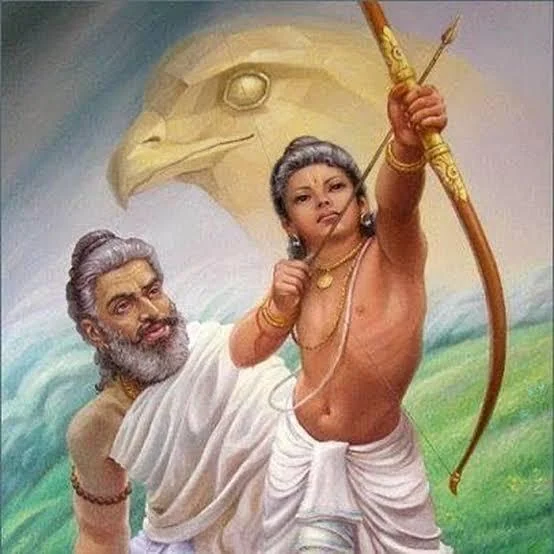
The Mahabharata has a beautiful story to this point. Arjuna, the great hero of the Bhagavad Gita, is a young man who, with his brothers and cousins, is studying with the great sage Drona. One day they are practicing archery. Drona points to a bird and tells the boys, one by one, to focus and aim an arrow at the bird. He asks the first boy, “What do you see?” The boy answers: “I see a bird on the branch of the tree in the forest.” Drona tells the boy he will never hit his target and to put the bow and arrow down. One by one the other boys answer more or less the same and Drona tells them not to bother shooting their arrow. Then he asks Arjun to come forward and take aim. “What do you see?” he asks. “I see the bird’s left eye,” says Arjuna, Drona tells him that it is impossible that he will miss the bird, and that there is no need to release the arrow to prove it. The moral: with single pointed concentration we cannot fail to miss our target. Without it we have no hope of success.
Concentration is to a large degree a learned quality and as such it can be lost. It is not “like riding a bike.” And Dharma is right, without concerted attention, without concentration, we accomplish nothing. Unable to hold our attention in one place for long, we jump from task to task and idea to idea depending on who or what comes into the field of our awareness. Studies suggest that “multitasking”, which is code for being distracted, results in at least a 40% loss of work efficiency, increases mistakes, impairs memory, leads to accidents and increases stress. Some studies even suggest that multitasking over long stretches of time diminishes the amount and density of grey matter in our brains. This can result in loss of higher cognitive functions and may contribute to dementia in later life. When we cannot concentrate we spin around and around from one thing to another without ever really going anywhere or accomplishing anything. So, how do we reclaim our attention span? How do we rebuild our concentration skills? How do we contribute positively and intentionally to the world?
Fortunately there are many options, and they are some of the most enjoyable things one can do in life!
Practicing yoga and other mindful movements like Tai Chi are an amazing way to develop not only greater concentration, but to integrate our concentration with our embodiedness.
Playing instrument, I mean, really playing it. Not a few chords, and not putting soundscapes together in GarageBand or some other app. Learn scales, fingering, bowing or breath techniques. Read music! If you want to play an instrument, it takes practice. As you cultivate musical skills you will also build the power of your concentration and your memory.
Reading novels. Don’t read simple things. Read complex, beautifully written words. I’ve been reading Thomas Hardy’s Tess of late. It is stunning writing, an amazing story, full of insights into the human condition, and it is challenging me. There are words I have to look up, idioms I don’t know, and I have to hold in my mind all that happens as the plot unfolds. It is work, but it is truly enjoyable. Take a stab at Don Quixote or Moby Dick or Things Fall Apart (they’re worth the trouble!) Or, read great poetry: Jorie Graham, Rilke, there are so many!
Writing, like reading, takes sustained effort and attention. Get some paper and a pen. We can’t write as fast as we type, and penmanship requires a level of proprioception that is very different than keyboarding. It slows us down and gives our thoughts time to unfold and mature and revise themselves. Writing (not typing) rewires our brain, too. Memory improves, and memory is a kind of attentiveness. But this is more than making lists and jotting down thoughts. Real writing requires writing and rewriting, shaping and crafting. It is an art more than a skill.
Gardening: gardening takes care and focus. You have to attend to the weather and the soil and the seasons and the plants and more all at once, but in a holistic way. It requires a kind of close listening to voices that are not human. This takes time to learn and to cultivate. Plus, it’s good for you physically, spiritually and good for the planet.
Sustained art projects like painting, quilting, mosaic and sculpture.
The above are just some of the ways to build concentration. But, all of these activities are “doings”. There is a more powerful tool for building concentration and attention, and that tool is meditation. The simplest way to start is to just sit comfortably in a place you won’t be disturbed (phone off!). Take a few deep breaths to relax, and then start silently counting your breaths: Breathing in one, breathing out one. Breathing in two, breathing out two. Count all the way up to ten following your breath. It sounds easy, but it takes practice just to hold your focus enough to count from one to ten. If you get distracted from your counting, start over. If you notice other thoughts arise while counting, start over. If you get all the way to ten, then start to count back down from ten to one. Once you can do this pretty easily, stop counting and try follow the breath.
There are other practices like zhine, shamatha, and trataka that build concentration and awareness. In these kinds of practices we train the mind to stay in one place. This is really hard at first. Staring at a candle flame or sacred image, we fix our attention and try not to let it move. But, of course, it does move. At first it probably moves more than it stays. And so we notice our distraction and gently guide our mind back to the flame or the image. Over time, the mind abide where it is placed. It’s a bit like training a puppy to sit and stay. Doing it again and again, one becomes able to go for longer periods, and also find that the mind can be happy just settling into place and resting on the object of attention.
Once we go from effortfully holding our attention on an object to effortlessly resting our attention on it, then we can take the object away and let the mind rest without anything to sustain it. Once again, this requires time and effort to stabilize. But, once we see the results (and they will come), it is so restful and peaceful. It brings healing to our hearts and souls and, energy to the body and builds our creativity.
The last step is to realize that, if the mind can rest evenly without and object, it can be this way all the time. Thoughts and emotions and sensation are all just objects that pass in and out of the field of awareness. We don’t have to follow thoughts: we let them come and stay and go. And emotions and sensations are the same. When we stop identifying with the objects of awareness and rather allow them to simply arise in awareness, they all become ornaments to a more natural, pristine state of mind. The mind becomes clear and bright. At this point there is no effort to make, no practice that needs to be done. We discover the freedom that meditation brings to turn our attention where it is needed, not where it is demanded. Some people call this “non-meditation, or non-dual meditation.
At this last stage, we are truly practicing what is often called open awareness, or non-meditation. It isn’t that we aren’t meditating, it is just that there isn’t a difference between formal meditation and other times. The awareness doesn’t change. At this point, we are always in a state of attention, of lucidity, of effortless concentration. You see this quality in the saints of all spiritual traditions. When you are with them they are 100% there, totally present. They aren’t thinking about dinner or the news or what’s next on their schedule. They are just present to what is, undistracted in body, speech or mind.
Dharma is right, without concentration one accomplishes nothing. More importantly, without concentration, self-realization doesn’t come and samsara just gets a little bit bigger every day. That is to say, we never find a way out of the suffering that we create with our minds, we just make more of it with or convolutions of thought and feeling.
My advice? Learn to sit, learn to pay attention to something small and simple like a candle flame. Really see it for an extended period of time over and over again. Then start to expand the depth and breadth of your attention. This let’s us start to see more while judging less, and our heartminds can grow to be as wide and as open as the sky!
Keep practicing!
sarva mangalam
Rob

Comments