
Time is weighing a great deal on my mind this week. I am in Abiquiu, New Mexico, and here it is almost impossible not to consider time. In this place, at any given moment, at every moment, one is confronted by many different scales of time simultaneously. There is the day-to-day life of Abiquiu’s denizens: the residents and guests (like me), the birds, cattle, elk, and skunks. And among the living are reflections of past life and lives. Next door to modern adobe homes are rusting, abandoned homesteads and mobile homes. Each one once had people living in them, some more recently than others. Life happened in them and now it does not. Time has moved on.
Across the highway are the Poshuouinge Ruins, a village abandoned by their Tewa Pueblo builders around 1475. The ruins are not even that: there are only the trace outlines of a walled village of 700 rooms in which several thousand people lived and died. One can, if looking closely, see the outlines in the soil where their rock walls once stood up to three stories tall. There is evidence of human life in and around Abiquiu going back 10,000 years. This is a land full of ancestral spirits, ghosts, and memory. And each of them is here, now, in the present moment.
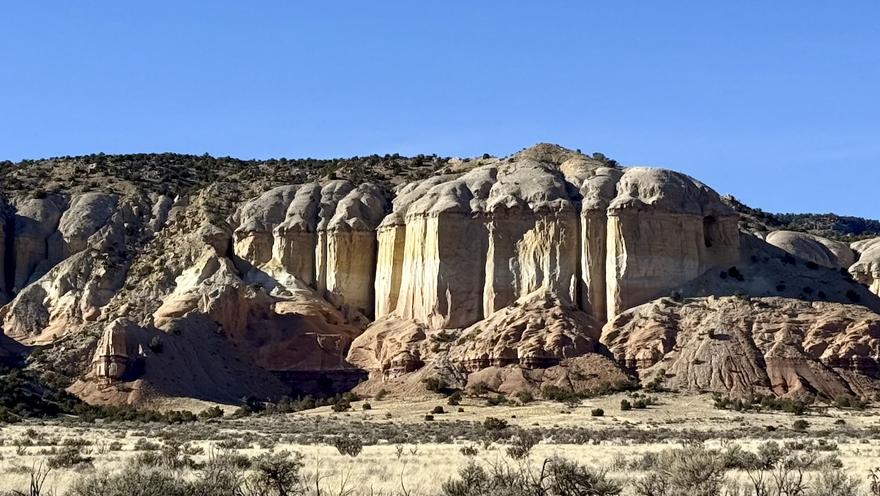
Moving beyond the human scale, this land is rich in fossils. Fossils of dinosaurs and creatures that predate the dinosaurs. The very soil is built of millions of years of living and dying by humans, mammals and creatures that we can barely imagine. This high desert plateau was once a tropical forest, and even an inland sea. Fossils of ancient precursors to the crocodile have been found: heads almost as large as my body. And these ancient remains lead us to yet another scale: geologic time. The stratification of the rocks and mountains of this area reveal hundreds of millions of years of activity and change. As in the picture at the top of this page, each striation represents another era, one layered on top of the other and all revealed together here and now as the foundation of this moment. And the next. And the one prior. We are slowly, ever so slowly bearing witness to the erosion of the landscape. What will be here in millions of years? And at the same time, we are ourselves constructing the future upon this past. We are making plans, working, building, and acting like this time is the only one, that we have always been here in this place and will always be here. In decades or centuries to come will those of the future be studying our ruined windmills, farmlands, skeletons and homes trying to explain what drove our behaviors? Will they try to explain how we came to this land and what drove us away? In the future it is us who will have left little trace, just like the Tewa Pueblo. What will our ruins say about us? What rumors and whispers of our passing will they hold?
*****
I have always liked watches, timepieces of all kinds. As a child I was fascinated by water-clocks and sundials, those early ways of drawing and quartering the day. The slow tick-tock of a grandfather clock could keep me awake or lull me to sleep depending on my mood. As an adult, I have measured out my days in minutes and hours, and sometimes even in seconds. I have an odd ability to almost always be able to guess the time within several minutes of what a clock or phone says. But here, in Abiquiu, surrounded by layers of time all happening at different velocities and yet all at once, there seems something false about clocks and calendars. What do we think we are measuring, and why?
The world turns. The sun rises and sets. The moon waxes and wanes. Seasons change. These things are true for all earthlings, from mountains to mayflies. This cycling is the only true measure of time. And what of it? There is no measure of years besides the rings of a tree and memory, and memories fade even as trees become soil or ash. The days pass, never to return. The past cannot be reclaimed. And no one will ever arrive at the future. For a being with life, the only true measure of time is that life itself, as it is lived. Before birth there is void and emptiness. Afterwards . . . . who can speak to afterwards? What comes is a great mystery.
To keep with mayflies and mountains, in this respect the two are the same: the length of time a mayfly lives, a single day, is a lifetime. That day is everything. And as a mountain rises from the crushing pressure of tectonic plates, so too will it be ground to dust. And leveled. Its life is a single life and its sole unit of measure. The only true measure of time is always one’s lifetime. The same is true for human beings. A human life, spanning many days, many moons, many orbits around the sun if we are lucky, is everything to the one who holds it. No span of time truly exists for us except for the one that is our own.
But, this is an impossible measure and a trick, for no one knows the hour of death. We only know that death comes to greet us the way it has everything that has ever been born. We will die. And so a lifetime is a useless unit of measure as it cannot see known or measured until after the fact. We can only see the span of others who die before us, not our own lifespan.
And so, here in Abiquiu - standing on exposed strata displaying hundreds of millions of years of transformation and change, building up and wearing down, surrounded by the echo of cultures (not only the Tewa Pueblo, many have come and gone here) whose remains are barely visible today, and the ruins of more modern homes abandoned and collapsing even as new ones are being built, I am surrounded by the past and looking toward a future. This place reveals to me without the shadow of a doubt that I too will come to ruin: ashes to ashes and dust to dust. But, this place also shows me something more: much more. All of this past is not prelude, it is always ever present. All exists now, only now. In my life at this moment everything is present, everything is unfolding itself in the field of my awareness. There is always only now. The past is now. Now is now. The future, when it comes, will be in the now, too. This field of awareness is all that I have, and it is an infinity of possibilities.
Listening to the afternoon winds as they howl through the rocks and kick up dust from the dirt road out front, I hear them say: “This, and only this. Always, only this. There is nothing greater than to be fully present to life in every moment. There is only this time, the one you are in here and now. Use it well. Live it fully. Live in deep communion with all that has ever been and will ever be. At the end of the day, we are all Mayflies. Love them while you can.”
Rob
February 26, 2026
Abiquiu, New Mexico

Comments